
 TR
TR  EN
EN 
Grey Iron vs Ductile Iron Castings: A Practical Buyer's Guide
Why this choice matters
Choosing between grey iron vs ductile iron is one of the first decisions in any casting project, and it shapes cost, lead time and how the part performs for years. Pick grey iron where ductile is needed and a bracket can crack under shock. Pick ductile where grey would do and you pay more for strength you never use.
This guide compares both materials in plain terms: how they differ, where each one wins, and what to ask your foundry before you place an order.
The one difference that explains everything: graphite shape
Both grey and ductile iron are iron–carbon alloys with roughly 3–4% carbon. The difference is the shape the carbon takes as the metal cools.
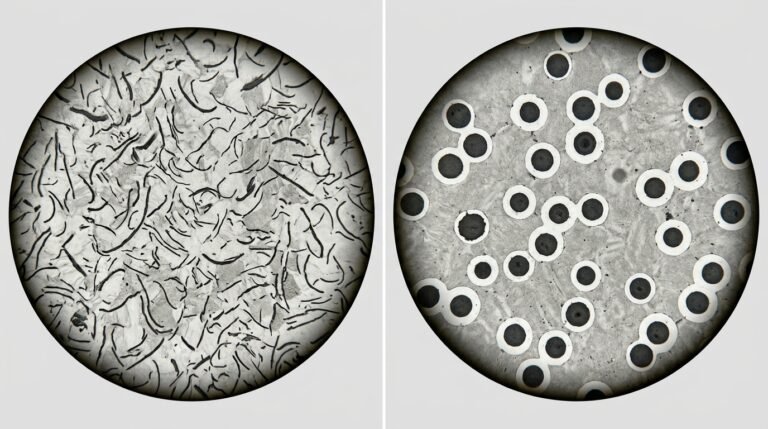
In grey iron, the carbon forms thin graphite flakes. Each flake acts like a tiny crack, so the metal is strong in compression but breaks with little warning under tension or impact.
In ductile iron (also called nodular or spheroidal graphite iron), a small addition of magnesium turns the graphite into round nodules. Cracks have no sharp edges to follow, so the metal bends before it breaks.
Grey iron castings: the reliable workhorse
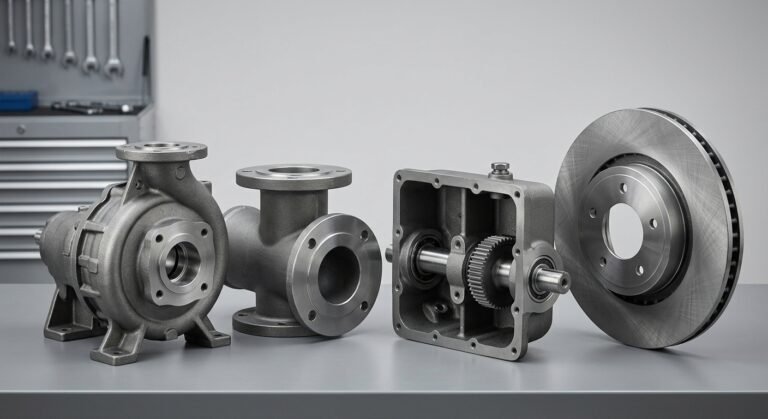
Grey iron is the most widely cast metal in the world because it is affordable, easy to pour and easy to machine. Its graphite flakes give it three strengths no other iron matches as well:
- Vibration damping: it absorbs vibration, which is why machine tool beds and engine blocks use it.
- Thermal conductivity: it carries heat away fast and resists thermal fatigue, ideal for brake discs and drums.
- Machinability: the graphite lubricates the cutting tool, so machining is faster and tooling lasts longer.
Typical parts: engine blocks and cylinder heads, brake discs and drums, pump and valve bodies, machine bases, manhole covers and counterweights.
Common grades: EN-GJL-200 and EN-GJL-250 (ASTM A48 Class 30 and Class 35 are close equivalents).
Ductile iron castings: strength with a safety margin
Ductile iron castings offer strength and toughness close to cast steel, at a lower cost and with better castability. Because the metal stretches before it fails, it is the safer choice wherever a part takes impact, pressure or cyclic loading.
- Tensile strength: roughly 400–900 MPa depending on grade, about double typical grey iron.
- Elongation: 2–18%, where grey iron is under 1%.
- Impact and fatigue resistance: much higher, so parts survive shocks and repeated loading.
Typical parts: water and sewage pipes and fittings, crankshafts, suspension parts and steering knuckles, gear housings, hydraulic components and wind turbine hubs.
Common grades: EN-GJS-400-15, EN-GJS-500-7 and EN-GJS-600-3 (ASTM A536 65-45-12, 80-55-06 and 100-70-03 are close equivalents).
Grey iron vs ductile iron at a glance
Property | Grey iron | Ductile iron |
|---|---|---|
Graphite shape | Flakes | Spheres (nodules) |
Tensile strength (MPa) | ~150–350 | ~400–900 |
Elongation (%) | Under 1 | 2–18 |
Impact resistance | Low | High |
Vibration damping | Excellent | Good |
Thermal conductivity | High | Moderate |
Machinability | Excellent | Good |
Relative cost | Lower | About 10–30% higher |
European standard | EN 1561 (EN-GJL) | EN 1563 (EN-GJS) |
US standard | ASTM A48 | ASTM A536 |
Values are typical ranges; the exact figures depend on grade, section thickness and heat treatment. Always confirm against the specification on your drawing.
How to choose: a 5-question checklist
Answer these five questions and the right material usually becomes obvious.
- Will the part take impact, shock or bending loads? Yes → ductile iron.
- Is it a pressure part, or safety-critical if it fails? Yes → ductile iron.
- Is vibration damping or heat dissipation the main job? Yes → grey iron.
- Is the part mostly in compression, like a base or housing? Yes → grey iron is usually enough.
- Is unit cost the top priority at high volume? Yes → start with grey iron and upgrade only if testing demands it.
When the answers point both ways, share the drawing and operating conditions with your supplier. A good foundry will recommend a grade, not just quote the one you asked for.
What to ask your cast iron foundry
The material grade is only as good as the process behind it. Before you order, ask your cast iron supplier for these:
- Material certificate (EN 10204 3.1): chemical composition and mechanical test results for each heat.
- Nodularity report (ductile iron): usually 80% or higher, checked by microstructure analysis.
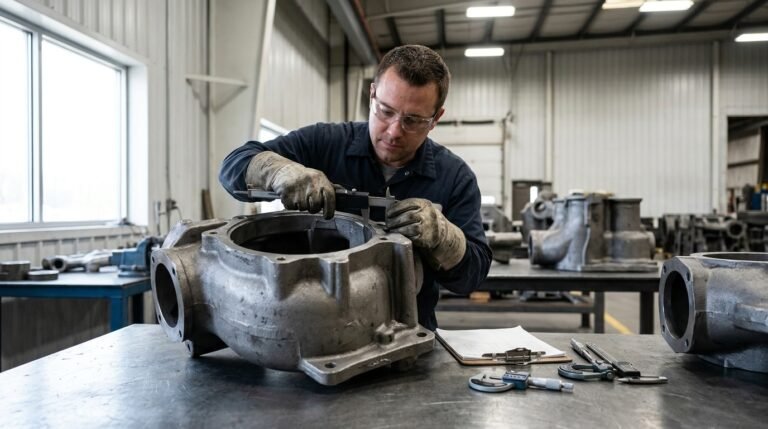
- Dimensional inspection report: measured against your drawing, with tolerances stated.
- Non-destructive testing where needed: ultrasonic, magnetic particle or X-ray for critical parts.
- Quality system: an ISO 9001 certificate at minimum.
- Packaging and logistics plan: rust protection, crating and delivery terms (Incoterms) for export orders.
Sourcing grey and ductile iron castings with Avax Plus
Avax Plus supplies grey and ductile iron castings to industrial buyers and handles the full path from drawing to delivery: grade selection, production, inspection, export documents and logistics.
Send us your drawing, annual volume and operating conditions, and our team will recommend the right grade and return a quote.
Frequently asked questions
Is ductile iron stronger than grey iron? Yes. Ductile iron typically has about twice the tensile strength of grey iron and can stretch 2–18% before breaking, while grey iron stretches less than 1%.
Why is grey iron still used if ductile iron is stronger? Grey iron is cheaper, machines faster, damps vibration better and conducts heat better. For bases, housings and brake parts, those properties matter more than toughness.
Is ductile iron the same as cast steel? No. Ductile iron reaches strength close to many cast steels but is easier to cast into complex shapes and usually costs less.
How can I tell grey and ductile iron apart? The reliable way is a microstructure check or a tensile test. Grey iron’s fracture surface also looks dull grey, while ductile iron’s looks brighter and more steel-like.
What does EN-GJS-500-7 mean? GJS means spheroidal graphite (ductile) iron, 500 is the minimum tensile strength in MPa, and 7 is the minimum elongation in percent.